
Plantation Shutters vs Blinds: Which Is Better for Melbourne Homes?
Plantation shutters are usually the better choice when you want a permanent fixture that controls light precisely and still looks right in fifteen years. Blinds are usually better when the budget is tighter, the window is an awkward shape, or you need a room to go completely dark. Some Melbourne homes get the best result using both.
- 300+ 5-Star Reviews
- 10-Year Structural Warranty
- Australian Made
- Free In-Home Measure & Quote
- 1000+ Shutters Installed
Shutters or Blinds - Which Should You Choose?
- A permanent fixture that stays with the house
- Precise light control without losing the view
- Insulation against Melbourne heat and winter draughts
- A finish that still looks right in fifteen years
- Better presentation on street-facing and living room windows
- Something children and pets cannot pull down
- A lower cost per window
- A softer look, or fabric that ties into the room
- Coverage for skylights, raked heads and very wide spans
- Something you can change in a few years without a renovation
- A blockout layer behind shutters in rooms that need to go dark
Plantation Shutters vs Blinds Comparison
Where Shutters Need Help from a Blind
Shutters are what we are known for, and on most windows they are the right answer on their own. There are a few places they need a second layer or a different product, and pretending otherwise just wastes everyone’s time at the quote.
Plantation shutter blades close tightly but they do not seal. A little light still comes through at the blade edges. In a living room nobody notices. In a west-facing bedroom in January, you will. The fix is not to give up the shutters, it is to run a blockout blind behind them. You keep the shutter on the window, and the blind does the blackout when you want it. That combination is what we fit in most bedrooms.
Panel width on a shutter is limited by weight and hardware. Wide sliding doors are handled with bi-fold or sliding shutter tracks, but skylights, curved heads and some raked windows are genuinely easier and cheaper in a blind.
Shutters cost more per window. If the budget stretches to six windows in shutters or the whole house in blinds, the better move is usually to stage it: shutters on the front rooms and the main living windows now, the back of the house later. A half-finished shutter job across the whole house is the outcome nobody wants.
A shutter is a fixture. It is painted or stained once and that is the finish for the next fifteen years. If you repaint and restyle a room every few years, fabric is the cheaper way to keep up.
Best Choice by Room
Shutters hold their finish in the room that gets the most use and the most visitors, and the tilt lets you keep the view while cutting glare on the television.
Shutters give you the look and the light control. If you need the room properly dark, add a blockout blind behind them rather than going without shutters.
Shutters survive being climbed on and have no cords, which matters in a child’s room. A blockout blind behind them handles daytime sleeps.
PVC shutters handle steam, splashes and regular cleaning far better than fabric, which holds moisture and marks.
Shutters are what people see from the kerb. They read as part of the house rather than a window covering, and they hold that look for years.
Bi-fold and sliding shutter tracks work well on standard sliding doors. On skylights and very wide or raked openings a blind is often the simpler answer. See our sliding shutters and bi-fold shutters.
How Much Light Control Do You Actually Get?
A plantation shutter gives you three positions rather than two. Blades open for full light, tilted for filtered light with the view intact, and closed for privacy without going dark. That middle setting is the one people notice. You can sit in a north-facing living room at four in the afternoon, cut the glare completely, and still see the garden.
A blind trades that for range at the extremes. A blockout roller gets a bedroom properly dark, which no shutter will do on its own. A sheer or sunscreen fabric softens light across the whole window rather than in bands. What you give up is the in-between: a roller is either down or it is not.
That is why the two work well together. Shutters on the window for the look, the privacy and the day-to-day light control, a blockout blind behind them for the nights and mornings you want the room black. It is one extra layer, not a different decision.


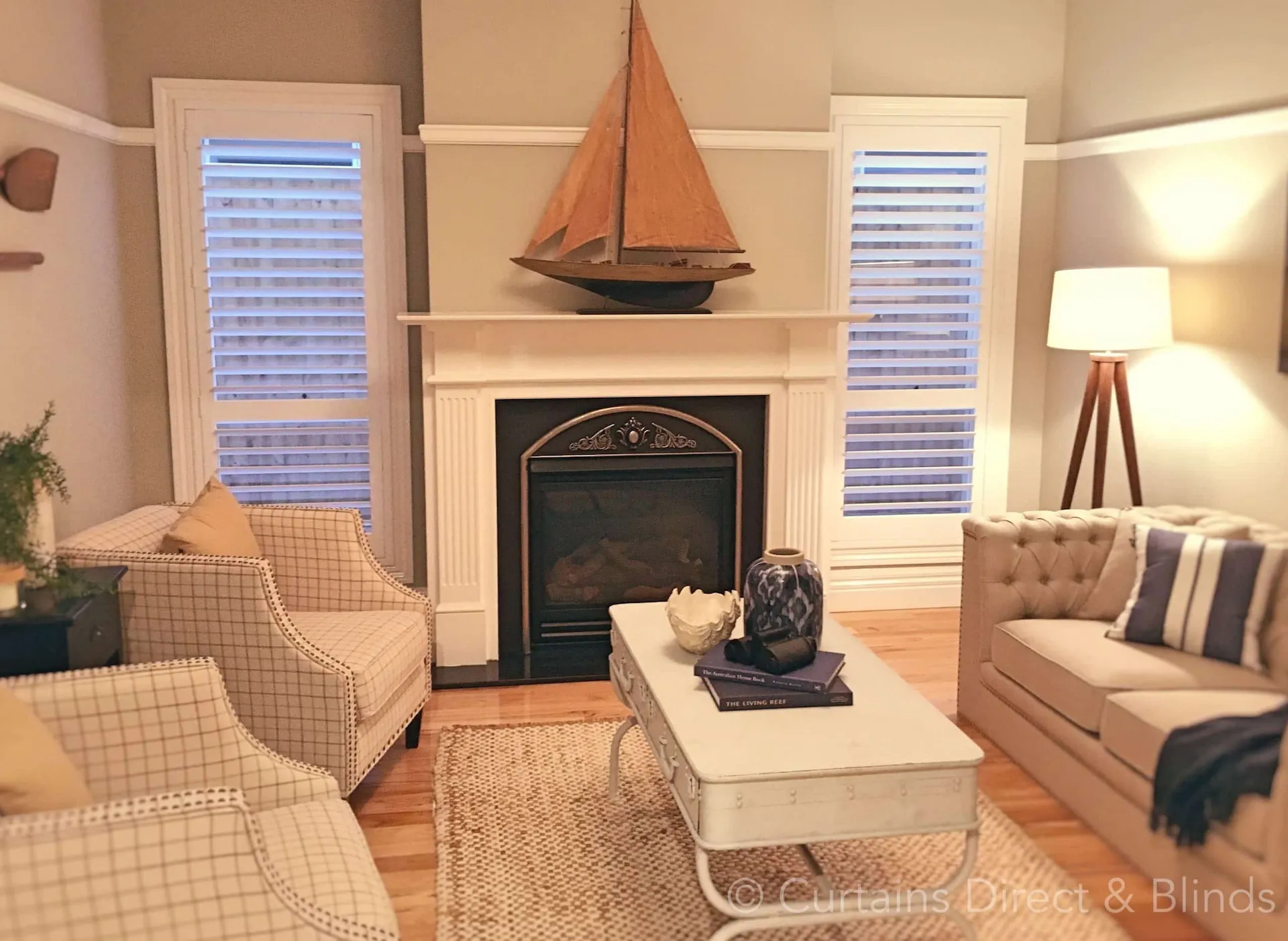
Durability and Melbourne Conditions
Shutters are built as a framed panel and fixed to the window, so there is no fabric to fade through and no cord mechanism to fail. PVC handles moisture and regular cleaning. Timber handles dry rooms and large panels. Both are built to last well past a decade when they are specified for the right room.
Blind life depends almost entirely on the fabric and the mechanism. Sun exposure is the usual killer: a north or west-facing window will fade and weaken a fabric years before the same blind on a south-facing window shows any wear. Chains and spring mechanisms are the other common failure point.
The answer usually comes down to:
- Sun exposure, especially north and west-facing windows
- How much moisture the room carries
- Window size and panel dimensions
- Whether children or pets use that room daily
- How long you plan to stay in the house
Both products last when they are matched to the room. Most of the failures we are called out to look at are a material put in the wrong place.
Maintenance Requirements
Shutters and blinds ask for different kinds of attention rather than different amounts. A shutter is easy to clean but there are more surfaces to get to. A blind has fewer surfaces but fabric is harder to clean properly once it marks.
PVC shutters are easier to maintain. They can usually be wiped down with water or a gentle cleaning solution, which makes them suitable for bathrooms, kitchens, laundries and family areas.
- Wipe blades with a damp cloth
- Gentle cleaning solution is safe on PVC
- Dry dusting for timber, keep it away from moisture
- No cords, chains or mechanisms to service
Timber shutters need more careful maintenance. They should generally be dry-dusted and protected from excessive moisture.
- Regular dusting, more often in living areas
- Spot cleaning only on most fabrics
- Fabric fades on north and west-facing windows
- Chains and spring mechanisms wear over time
Cost: Plantation Shutters vs Blinds
Shutters cost more per window than blinds. How much more depends on the window rather than on a per square metre rate, which is why the figures floating around online are close to useless. Most of them are scraped off DIY and flat-pack suppliers, so they leave out freight, installation, and the risk of measuring your own windows. An installed job and a flat-packed one are not the same product at the same price.
For real installed figures by window type, see our plantation shutters pricing guide. For a price on your own windows, book a free measure and quote. We price shutters and blinds on the same visit, so you can see the gap on your own house rather than on an average.
- Window size and the number of panels
- Frame type and profile
- Blade size: 63mm, 89mm or 114mm
- Colour or stain finish
- Mount position, inside the recess or face fixed
- Custom shapes, raked heads and curved windows
- Standard windows compared with sliding or bi-fold doors
Warranty Considerations
Plantation shutters commonly carry a longer structural warranty because the panel is built to hold its shape. There is no fabric to fade and no mechanism to wear, so what is being warranted is the frame, the blades and the hardware.
Blind warranties vary far more, because they cover two different things: the fabric and the mechanism. Fabric warranties are usually the shorter of the two, and sun exposure is the condition most often excluded or limited.
Warranty should always be read next to where the product is going. A blind on a south-facing study window and the same blind on a west-facing living room window are not the same risk, and the warranty is written with that in mind.
10-Year Structural Warranty
Plantation Shutters
Warranty Varies by Product and Fabric
Blinds
Which One Should You Choose?
- A fixture that stays with the house
- Precise light control with the view intact
- Something that holds its look for fifteen years
- Better presentation on the facade and living areas
- A lower cost per window
- Fabric, colour and texture options
- A practical answer for skylights and wide spans
- A blockout layer behind shutters where a room must go dark
- Shutters on the facade and the main living windows
- Shutters plus a blockout blind behind them in bedrooms
- PVC shutters in bathrooms, kitchens and laundries
- Both quoted in the same visit, so you see the full picture
See Shutters and Blinds Side by Side
- Free measure and quote
- On-site design advice
- Shutter and blind samples brought to you
- A room-by-room recommendation with pricing for both
- Moorabbin: 1022 Nepean Hwy, Moorabbin VIC 3189
- Pascoe Vale South: 12 York Street, Pascoe Vale South VIC 3044
- See shutters and blinds side by side
- Bring rough window measurements and photos for an initial estimate
- Showroom visits by appointment only
Common Questions About Shutters and Blinds
They are better at different things. Shutters win on light control, on how long they last, and on how the front of the house reads from the street. Blinds win on cost per window, on skylights and very wide spans, and on getting a room properly dark. On most Melbourne homes the right answer is shutters on the facade and the living areas, blinds where a room has to black out.
On the windows people see and sit next to, yes. A shutter is a fixture that stays with the house and still looks right in fifteen years, where a blind is usually replaced by the next owner. On a laundry window or a skylight the extra spend buys you very little. That is why we quote both on the same visit rather than pushing one material across every window.
No. The blades close tightly but they do not seal, so a little light still comes through at the blade edges. In a living room nobody notices. In a west-facing bedroom in January you will. The fix is not to give up the shutters, it is to run a blockout blind behind them.
Yes, and it is what we fit in most bedrooms. The shutter stays on the window for the look, the privacy and the day to day light control, and the blind sits behind it and does the blackout when you want it. It is one extra layer, not a different decision.
Blinds, per window, every time. How much cheaper depends on the window rather than on a per square metre rate, which is why the figures floating around online are close to useless. Most of them are scraped off DIY and flat-pack suppliers, so they leave out freight and installation. Our pricing guide gives real installed ranges by window type.
They read as part of the house rather than as a window covering, which is the practical difference. A buyer walking through sees fitted joinery on the windows instead of something the last owner bought and will take away. We would not put a number on the resale effect, but shutters stay with the house and blinds usually get replaced.
Shutters, by a wide margin. Fifteen to twenty years and more is normal, because there is no fabric to fade through and no cord or spring mechanism to fail. Five to ten years is typical for a blind, and sun exposure is what decides it: the same fabric on a north or west-facing window fails years before it does on a south-facing one.
Shutters. A closed shutter is a solid panel across the whole opening, so it cuts both summer heat and winter draught. A blind varies a great deal with the fabric and with how well it fits the reveal. If insulation is the reason you are buying, mount position matters as much as the material, and that gets decided at the measure.
Both, layered. Shutters give you the look, the privacy and the in-between light setting, and a blockout blind behind them handles the nights and the daytime sleeps. If the budget only stretches one way in a bedroom, take the shutter and add the blind later. A blind can be retrofitted behind a shutter; the reverse is a rebuild.