
Blinds are cheaper. Shutters last longer. That’s the short version.
If you’re comparing window treatments for a Melbourne home, you’re probably weighing plantation shutters against roller, roman or venetian blinds. Both do the job. But they solve it differently, and the right answer depends on how long you’re staying, how much you want to spend, and what you want the room to feel like.
Here’s the honest breakdown.
The basic difference
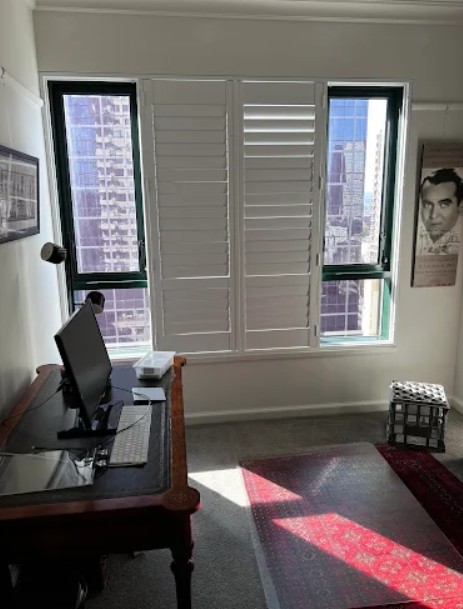
Plantation shutters are permanent fixtures. Custom-fitted panels with wide horizontal louvres, mounted directly to the window frame in your home. They’re solid, tailored, and treated like a piece of architecture. When you sell the house, they stay.
Blinds are removable window coverings. They hang from a track or bracket above the window, roll or fold, and can be swapped out when you redecorate. They’re softer visually and much lighter to install.
Cost comparison
Blinds win on upfront cost, no contest. Basic roller blinds start around $80 per window. Premium made-to-measure venetians or romans sit around $200 to $400 per window. Motorised or fabric-heavy blinds can push higher, but for a standard Melbourne home, blinds usually come in under $500 per window.
Plantation shutters are more expensive upfront. Custom shutters typically range from $500 to $1,500 per window depending on material and size. PVC is at the lower end. Timber and aluminium sit higher.
The reason for the gap: shutters are a bespoke build. Every panel is measured, manufactured and installed to your window. Blinds are typically off-the-shelf sizes or lightly customised.
Long-term though, the maths flips. Blinds have a functional life of 5 to 10 years before the mechanisms wear, the fabric fades, or the tracks fail. Shutters last decades. If you’re staying in the home, the per-year cost of shutters is often less than replacing blinds every 7 years.
Durability
Shutters win comfortably. A well-installed plantation shutter should last 20 to 30 years without needing replacement. Basswood timber, aluminium and PVC shutters all carry manufacturer warranties in the 10 to 20 year range.
Blinds are functional but they wear. Cords fray. Roller mechanisms fail. Fabric sags or fades in sunlight. Slats bend on venetians. None of these are catastrophic, but they mean blinds are a rolling replacement cost every 5 to 10 years.
Light control and privacy
Both give you good light control, but the mechanism is different.
Shutters use adjustable louvres. Tilt them fully open and you get maximum light with the shutter still down. Tilt them closed for privacy without losing airflow. It’s fine-grained control, room by room, mood by mood.
Blinds usually operate as fully open or fully closed. Some (like venetian slats) offer some louvre-style adjustment, but not to the same degree as shutters.
For total blackout, neither shutters nor blinds achieve 100% on their own. Shutters get you 95% but light will bleed through the louvre gaps. If total darkness is critical (shift workers, day-sleepers, home cinemas), you’ll want blackout blinds or a shutter-plus-blackout-blind combo. We wrote a separate guide on that.
Look and feel
Shutters look permanent. Because they are. A shutter fits the window like joinery. You notice the panel, the frame, and the finish. It reads as part of the house’s design rather than a soft furnishing.
Blinds are softer, more flexible visually. They add texture and can be swapped when your interior evolves. If you like changing decor every few years, blinds move with you. If you want your window treatment to feel like it belongs, shutters win.
Property value follows the same pattern. Real estate agents in Melbourne consistently rate plantation shutters as adding measurable resale value to a home. Blinds don’t.
What suits Melbourne homes best
For most Melbourne homes, plantation shutters are the better long-term investment. Here’s why:
Melbourne’s temperature swings and humidity variance suit shutters. PVC handles bathrooms and laundries without warping. Timber suits the drier main living areas. Aluminium handles outdoor patios and pergolas.
Melbourne homes typically have larger windows and higher ceilings than average. Shutters scale to those windows cleanly. Blinds on 3-metre-tall windows look and feel underweight.
Melbourne’s design vernacular – Federation, Californian bungalow, Victorian, mid-century, contemporary – all suit plantation shutters. They read as considered architecture, not a soft add-on.
The exception: transitional or short-stay properties where the design isn’t finalised. If you’re renovating in stages, or renting out with plans to change tenants in 12 months, blinds give you flexibility.
When blinds are the better call
Blinds win when budget is tight (quality blinds cover the window for less than shutters), when the home is temporary (investment properties, short-term rentals, or houses about to be sold), when the window is unusual (some skylights, awkward angles or tiny openings suit blinds), or when total blackout is the primary goal (a blackout roller blind achieves what a shutter can’t on its own).
Making the call
For most Melbourne homeowners staying put for 5+ years, plantation shutters are the better call. Higher upfront cost, better lifespan, better light control, better property value. The maths works out.
For short-stay or renovation-in-progress homes, blinds are pragmatic.
If you’re on the fence, book a free in-home measure and quote. We’ll walk through the windows in your home, talk through the trade-offs on each one, and give you an honest recommendation – including ‘blinds would be fine here’ where that’s the right answer.